Risk

Six layers. One fill path. Rules you can defend.

Every open, modify, and close is scored against the program in memory — violations, news windows, scalping/HFT, grid/martingale, multi-account, and IP/geo. Breach, flag, or clear with the same latency budget as the terminal. Replay is a first-class admin action.

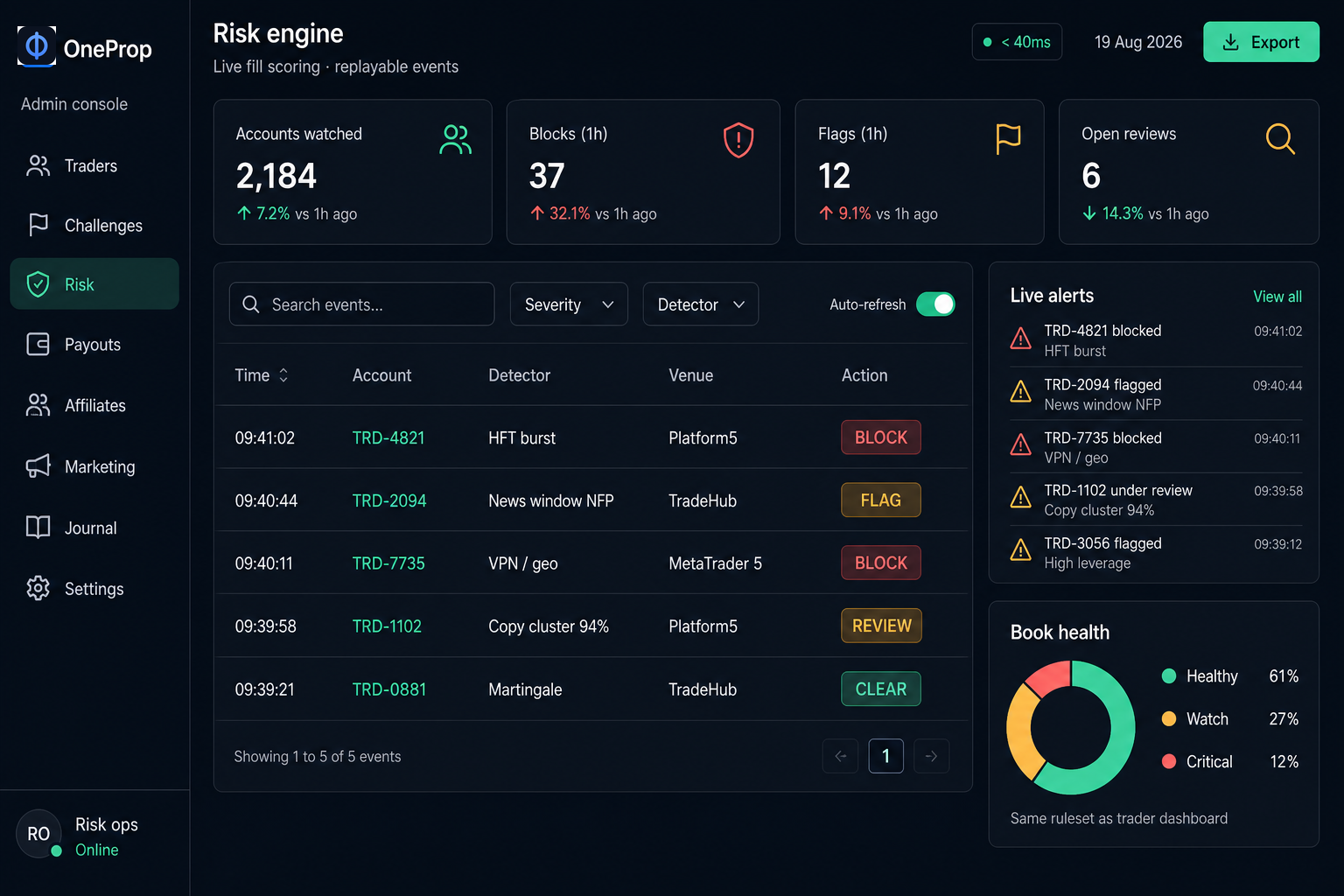
OneProp risk engine showing blocked and flagged events
Layers

Hover a layer. Click to pin the spec.

These are parallel detectors on the same account, not six products. Thresholds and actions are fields on the program and phase. We name the signal so you can explain the fail.

Pipeline

Event in. Named class out. Then you enforce.

This is not a nightly batch. Login, terminal connect, pending placement, and every fill hit the same graph. Phase-2 rules that do not match the site lose arguments you should have won.

Ingest

Open, modify, partial, close, pending, auth, and terminal connect — from native terminals and bridges. Delayed streams are labeled delayed.

Account state

Equity, floating P&L, open book, pending geometry, identity graph. Daily and max drawdown can sit on independent bases.

Compiled rules

Program + phase objects. Hot-swap parameters without a deploy. Rule chaining: three mediums in 24h → review; news window AND exposure cap.

Classify

A named class and a severity — not a mystery score. Composite HFT is only the six listed signals.

Enforce

Warn, flag, reject the next add, flatten, read-only, fail, or hold payout. Per rule and per phase.

Audit

Immutable event log the trader can also see. Webhook out. Admin replay with the fill list that tripped it.

Classes

Named violations. Severity is a field.

Typical operator mapping — not fake trader names. You can warn on challenge and fail on funded for the same class.

ClassWhat trips itTypical action
Daily / max drawdownIndependent bases: trail, static, equity, pip/absolute, weekly. Warning rungs before hard breach. Optional grace window.Flatten rest of day, or fail
News windowMapped event, independent pre/post minutes, instrument map (USD release need not lock GBP). Hold-through is a separate class — no double-count vs drawdown.Reject / flag / flatten
Weekend / sessionFriday cut-off with symbol exceptions; London / NY / Asia / custom windows. Thin-session harvesting is a policy, not a vibe.Flatten or block new
Min / max holdCannot close before N seconds (per symbol group). Force-close after a duration on funded books that should not carry a hedge forever.Flag / HFT score / flatten
HFT burstRolling 1 / 5 / 60 minute frequency caps plus tick-scalp repeats. Score decays so one fast session does not brand the account forever.Block / review
Latency arbFill vs mark (or LP) timestamp gap. Hit-rate over a window — not one lucky fill. Especially on CFDs.Block
Martingale / averagingClassic 2×, Fibonacci, fuzzy 1.8× / 2.1×, and adds to a loser without a clean double. Cross-session and cross-symbol lookback.Reject the next add
Grid geometryEquidistant pending cluster (typically 5+ workings), bi-directional “hedge” grids, max concurrent per symbol and direction. Caught before they fill.Flag / reject
Copy / hedge pairTiming, instrument, side, size overlap. Opposite-side pairs on the same tick. Evidence pack: fills, identity, timeline.Review / payout hold / lock
VPN / TOR / geoPath class (VPN, proxy, TOR, datacenter vs residential), declared KYC vs resolved geo, shared-IP farms, device/terminal ID across logins.Warn, case, or block
Size / instrumentMax lot, min size, aggregate exposure, single-symbol concentration, allow/deny lists, per-symbol caps on the names they actually blow up.Reject at the gate
EA / target gamesAlgo policy per program; stop/swap abuse; one-tick scalp into a pass; correlated hedges; overnight gap lottery. Logged as its own class.Flag or fail
How the layers differ

News, HFT, grid, copy, and IP are not one toggle.

News maps, not a global lock

Per-event windows 1–60 minutes. Instrument maps: NFP can lock USD pairs and XAU and leave GBP open. Hold-through on positions opened before the window. Override one event without restarting the engine. Calendar is your feed or a connected calendar — not a retail widget we pretend we own.

Six HFT signals, all listed

Min hold, burst windows, tick-scalp repeats, latency-to-mark, news-spike scalp, duration-threshold gaming. Composite only from those. False positives go to a review queue before a hard fail. Tighter as they approach payout. One short trade is not HFT; a 47-fill burst in three minutes is.

Grid before the tombstone

Lot-step after losses, pending geometry, averaging-down, Fibonacci, bi-directional grids. Fuzzy ratios catch 1.8× and 2.1×, not only textbook 2×. Cross-symbol recovery when they hop pairs to hide the ladder. Catch the fourth rung.

Multi-account evidence packs

Copy rings, challenge-to-funded mirrors, long/short hedge pairs, farm clusters, loss allocation, credential sharing. Timing, instrument, direction, size, and identity are separate dimensions. A 94% overlap is a review. A guaranteed long/short pair on the same tick is a hold.

IP class, not a brand list

VPN/proxy, TOR exit, datacenter vs residential, geo vs KYC, shared-IP (N accounts, same network, your window), device and terminal identifiers when the IP hops. Whitelist the office. Counsel owns the restricted-geo list.

Lot, leverage, toxic flow

Lot spikes vs history and caps, leverage per program, instrument bans, behavioral clusters you name. Review queue — not a score you cannot defend in a payout dispute.

Library

The catalog ops actually compiles.

Drawdown, position, time, strategy, instrument, network, and custom chaining. Filter a category, hover a rule, pin the spec. Parameters hot-swap. Code is not required to change a threshold.

Enforcement, not a dashboard toy.

Tiered alerts (80 / 95 / breach), webhook out, trader-visible gauges, and an immutable event log. Daily and max drawdown can use different bases on the same account.

We give you real-time exposure, named detectors, and the fills you need to hedge. We do not staff a shadow risk department or warehouse your book.

Challenge engine → · Admin CRM → · Risk events on the API →

Risk monitorLIVE PREVIEW

Illustrative event stream. Your production ruleset is the source of truth.

FAQ

What operators ask before they trust a fail.

Do you sit on our risk committee?

No. We compile and enforce the rules you write, surface exposure so you can hedge, and keep an immutable log. We do not warehouse your book or staff a shadow desk. If someone sells “our risk team as an extension of yours,” that is a service contract — price it separately from the license.

Is this a machine-learning score?

No. Detectors are named signals: hold time, burst windows, fill-vs-mark gaps, lot steps, pending geometry, copy overlap, VPN/TOR/datacenter class, geo vs KYC. A composite is only those fields. We will not sell a black-box score you cannot defend to a trader or a regulator.

How fast does a rule fire?

On the fill path, with the same latency budget as the terminal — not an end-of-day CSV. We do not invent a sub-50ms SLA. If a venue only gives us a delayed stream, that ingest is labeled as delayed.

Whose economic calendar do you use?

Yours, or a connected calendar you attach. We do not pretend Forex Factory or a retail widget is our product. Per-event pre/post windows and instrument maps are first-class; a global “no news” toggle is how you punish the wrong book.

Do you detect every VPN brand?

We classify the path: VPN/proxy, TOR exit, datacenter vs residential, geo vs declared KYC, shared-IP clusters. Policy is yours — whitelist the office, warn on challenge, block at payout. We do not sell a “1000 VPN brands” slide.

Can rules differ by phase?

Yes. Challenge, verification, and funded can use different thresholds and actions on the same account. Daily and max drawdown can sit on independent bases. That is how real programs are written.

Put your abuse cases on the table.

We configure detectors to the strategies you actually see — not a generic antivirus slide.